
News
Ireland’s alcohol advertising controls

In our latest blog, Dr Sheila Gilheany, CEO of Alcohol Action Ireland, reflects on Ireland’s experience of implementing restrictions on alcohol marketing and advertising - along with a range of other public health measures including minimum unit pricing and labelling laws. Sheila describes the positive impact these measures have had in reducing alcohol consumption in Ireland, and reflects on learning for countries such as Scotland who may be exploring their own restrictions on alcohol marketing and advertising.
We publish this blog following the recent publication of the long awaited Public Health Scotland Rapid Review of Evidence on Alcohol Marketing and Advertising - which found that alcohol marketing was pervasive and persuasive, increases alcohol consumption and harm, and recommended that Scotland implement restrictions.
by Dr Sheila Gilheany, CEO of Alcohol Action Ireland
In recent years, Ireland has rightly drawn plaudits for its public health approach to alcohol. A groundbreaking piece of legislation was passed in 2018 which provided for 31 measures based on the World Health Organisation’s ‘best buys’ of actions on price, availability and marketing. They included Minimum Unit Pricing, controls on the sale of alcohol such as special offers, structural separation of alcohol in shops, health information labelling and some modest restrictions on advertising. The legislation was designed to work as a package with the aim of reducing Ireland’s per capita alcohol consumption by 20% and specifically to reduce the exposure of children to alcohol marketing.
The legislation had its origins in a landmark report from the Department of Health published in 2012 in response to alarming levels of alcohol consumption and its attendant harms. Just some of the data presented in the report included Ireland’s high levels of per capita consumption (11.9 litres in 2010 and one of the highest rates globally of heavy episodic drinking (with one-quarter of Irish adults reporting that they binge drink every week). Of particular concern was that at that time, over half of Irish 16-year-old children have been drunk and one in five was a weekly drinker. Alongside these key indicators was evidence on the high level of alcohol harm in Ireland including hospitalisations, mental health impacts, deaths, drink driving and assaults including domestic and sexual violence.
Advertising
Advertising of alcohol was recognised as a key driver of both the initiation of drinking in adolescence and in encouraging it in those who were already drinking. As noted in the report, Irish 16–21 year olds listed alcohol advertisements as five of their top ten favourite advertisements, while four in ten 16–21 year olds had an alcohol branded item of clothing, with 26 per cent owning a rugby/football jersey that had an alcohol brand logo.
The report made a series of recommendations including complete bans on alcohol sports sponsorship, outdoor advertising, a broadcast advertising watershed and strict controls on content of advertisements. Following massive levels of industry lobbying, what finally emerged in legislation in relation to advertising was considerably watered down from the original strong proposals but included bans on:
- outdoor alcohol advertising within 200 m of schools, public parks and other youth-oriented facilities, on public transport and on the field of play during sports matches
- alcohol advertisements in cinemas except for over 18 films
- alcohol sponsorship of youth sports events and motor racing
- alcohol branded clothing for children
- advertising in shops except in designated areas behind a 1.2m height barrier
- advertising on television from 3am to 9pm and on radio on a weekday from 3pm to 10am the following morning.
Very slowly these measures have been implemented with the broadcast watershed being the latest to come into effect from Jan 2025.
In addition, there are two outstanding measures yet to be implemented – controls on alcohol advertising in print media and on the content of advertisements. The latter is designed to strip out myth making from alcohol advertising so that ads will only contain factual information such as price and origin of the product. In addition, ads must carry specific warnings including that alcohol causes fatal cancer and about drinking in pregnancy. These warnings are designed to dovetail with another measure which provides for warning labels on alcohol products, now delayed until 2028.
What has been the effect?
The government has established a working group to examine the evidence of the impact of the legislation which has not yet reported. However, since the passage of the Act, alcohol consumption has dropped by 15%, now standing at 9.5 litres per capita. It seems likely that at least some of this reduction is due to the impact of the measures. For example, when Minimum Unit Pricing was introduced in 2022, consumption dropped by 5% that year.
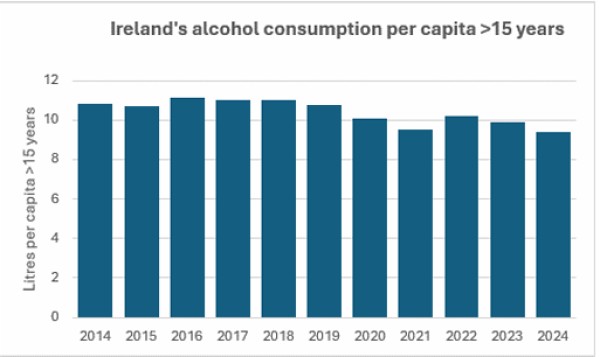
There have been some improvements in relation to youth drinking. For example, the 2024 European School Survey Project on Alcohol and Other Drugs (ESPAD) found that lifetime alcohol use amongst 15–16-year-olds in Ireland dropped from 72% in 2019 to 67% in 2024. However, binge drinking rates both in youth and across the entire population remain high.
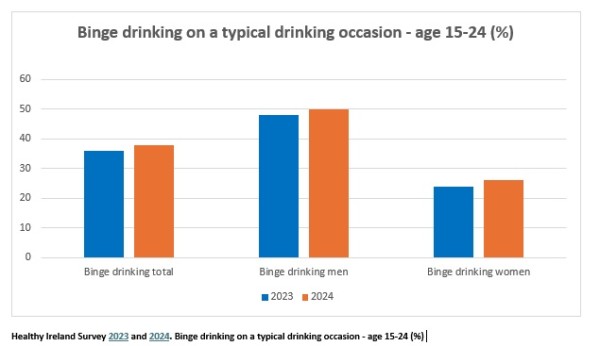
Healthy Ireland Survey 2023 and 2024. Binge drinking on a typical drinking occasion - age 15-24 (%)
Overall, in 2024, 28% of the population over the age of 15, binge drink on a typical drinking occasion. This is an increase from 24% measured in 2023 and shows a return to the level measured in 2018.
Limitations
The legislation is only being implemented slowly and important parts do not even have implementation dates. Industry lobbying has contributed to this delay and recent research points to the importance of an implementation plan to counteract this. As well as not going as far as the original recommendations, the legislation does not provide for any controls on internet advertising which is a serious gap. Another issue is that there has been a proliferation of advertising of zero alcohol products using identical branding to master brands in the spaces and times which are restricted for alcohol advertising.
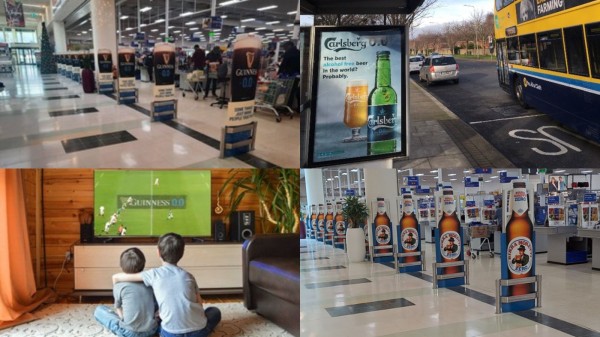
Not surprisingly, research in other jurisdictions indicates that exposure of teenagers to zero-alcohol drinks has a similar effect to exposure to alcoholic drinks.
The broadcast watershed has not prevented high profile sports events which are sponsored by alcohol brands being transmitted during the day. There are also multiple instances of alcohol branding appearing on the field of play during matches in addition to zero alcohol product references.
Looking forward
In summary, Ireland’s legislation appears to have brought about some improvements in relation to alcohol consumption. It points to the importance of taking a strong public health approach to alcohol legislation and the need for well-resourced implementation plans for monitoring and compliance. However, it remains vulnerable to the impact of industry lobbying both in the design phase of legislation and in enactment. A key lesson might be that the most effective legislation particularly on alcohol advertising is to have complete bans as opposed to partial measures which become open to interpretation.
Ireland certainly benefited from Scotland’s determined approach to introducing Minimum Unit Pricing in 2018. Hopefully, Ireland’s experience on other measures including advertising will be of help to Scotland and indeed other jurisdictions considering action in this area.
 RSS
RSSeFocus newsletter
Our monthly eFocus newsletter features all of the latest news from Alcohol Focus Scotland on our key strategic work areas, as well as news of upcoming AFS training and events, briefings, consultation responses and more.
We also feature news from the wider alcohol sector, including on alcohol policy, practice, events and latest research.
